
No-Step Living After 60: A Flooring and Threshold Audit for Families
A practical audit for families checking door sills, lift lobbies, bedroom-to-bathroom routes, balcony tracks, shower entries, rugs, ramps, outdoor paving, and temporary walker use.
Quick Answer
No-step living means the elder can move through daily routes without repeatedly lifting feet over avoidable lips, curbs, tracks, uneven mats, or surprise level changes. Families should audit the full path: lift lobby to front door, entrance to bedroom, bed to bathroom, toilet to shower, kitchen to dining, room to balcony, apartment to garden, and parking to lift. The test is not whether the home looks smooth in daylight. It is whether the parent can cross each transition slowly, in slippers, at night, after fatigue, during recovery, or while using a cane, walker, wheelchair, or caregiver support.
Design safety note
This guide is educational and does not replace advice from qualified architects, accessibility consultants, occupational therapists, physiotherapists, doctors, emergency responders, or licensed care providers. If an older adult has repeated falls, dizziness, confusion, sudden weakness, injury, severe pain, breathing difficulty, or immediate danger, seek urgent local medical help.
8
routes to walk
Door, bathroom, balcony, kitchen, lift, garden, parking, and emergency routes need separate checks.
wet + dark
is the hard test
Bathroom entries, balcony tracks, and night routes expose the most dangerous transitions.
6 weeks
temporary support
A home should still work if a parent needs a walker after surgery, illness, or a fall.
Audit the route the elder actually walks
A threshold is not only a construction detail. It is a daily movement decision. A door sill, raised bathroom curb, loose mat edge, balcony track, uneven stone, ramp start, or lift lobby lip may be crossed dozens of times every week.
The audit should follow real routes, not isolated rooms. Walk from lift to front door, front door to bedroom, bed to bathroom, toilet to shower, kitchen to dining table, prayer area to seating, room to balcony, and apartment to garden. Repeat the route after sunset, because a small edge becomes more serious when contrast and attention are lower.
Ask the elder to walk at their natural pace. If they look down constantly, touch a wall, shorten their stride, pause before a lip, or avoid a balcony or garden route, the flooring is already reducing independence.
Balance grip, cleanability, and visual clarity
A senior-friendly floor is not simply rougher. It must give grip without catching slippers, walker feet, wheelchair wheels, or housekeeping tools. It should be easy to clean, stable when wet, and predictable under changing light.
Families should be careful with glossy stone, loose rugs, curled mats, thick carpets, heavy texture changes, patterned tiles that hide edges, and floor colors that make level changes disappear. A premium finish is not premium for ageing if the elder must watch every step.
Inspect the floor under real conditions: bathroom entry when wet, balcony track after rain, kitchen after oil or water spills, puja area after flowers or dust, and corridors during evening light. The question is not whether the floor looks clean; it is whether the next step is obvious.
Treat ramps and balcony tracks as risk zones
A ramp is useful only when it is designed with the right slope, landing, handrail, width, surface grip, drainage, lighting, and turning space. A steep decorative ramp can be harder than a step, especially with a wheelchair, walker, rainwater, or weak knees.
Balcony tracks deserve the same seriousness. They look small during a site visit but are crossed during tea, drying clothes, watering plants, phone calls, and evening air. They should be visible, lit, easy to cross, and not placed where wet feet or low contrast make the edge hard to read.
No-step living should also support temporary decline. A parent may be mobile today and need a walker for six weeks after illness or surgery. The home should not become unusable just because mobility changes for a short period.
No-step living audit checklist
Lift lobby to front door
Check lift threshold, corridor flooring, door sill, mat edge, lighting, turning space, and whether a walker or wheelchair can enter without lifting.
Bed to bathroom route
Walk this route at night in slippers. Look for rugs, furniture corners, dark thresholds, bathroom lips, and places where the elder touches walls for support.
Toilet and shower transitions
Check shower curb, drainage lip, wet floor grip, towel reach, dry changing zone, and whether a chair or caregiver can fit without blocking exit.
Balcony door track
Test the track during daylight and evening. Ask whether the parent can cross it while carrying tea, using slippers, or stepping back inside after rain.
Kitchen and dining route
Check for spills, floor glare, mat edges, sudden tile changes, and whether hot food can be carried without stepping over a lip.
Rugs and decorative mats
Remove loose rugs where possible. If a mat is needed, it should be flat, fixed, high contrast, and not curl at the edges.
Ramp and parking path
Check slope, handrails, landing space, drainage, lighting, and whether the route still works when it rains or a wheelchair is used.
Six-week recovery test
Imagine the parent using a walker after surgery. If the route needs lifting, twisting, or furniture moving, it is not recovery-ready.
Threshold decisions families should test
| Design feature | Why it matters | Family question |
|---|---|---|
| Front door sill | It is crossed with bags, slippers, guests, walkers, and emergency movement. | Can the elder enter without lifting feet high or catching a mat edge? |
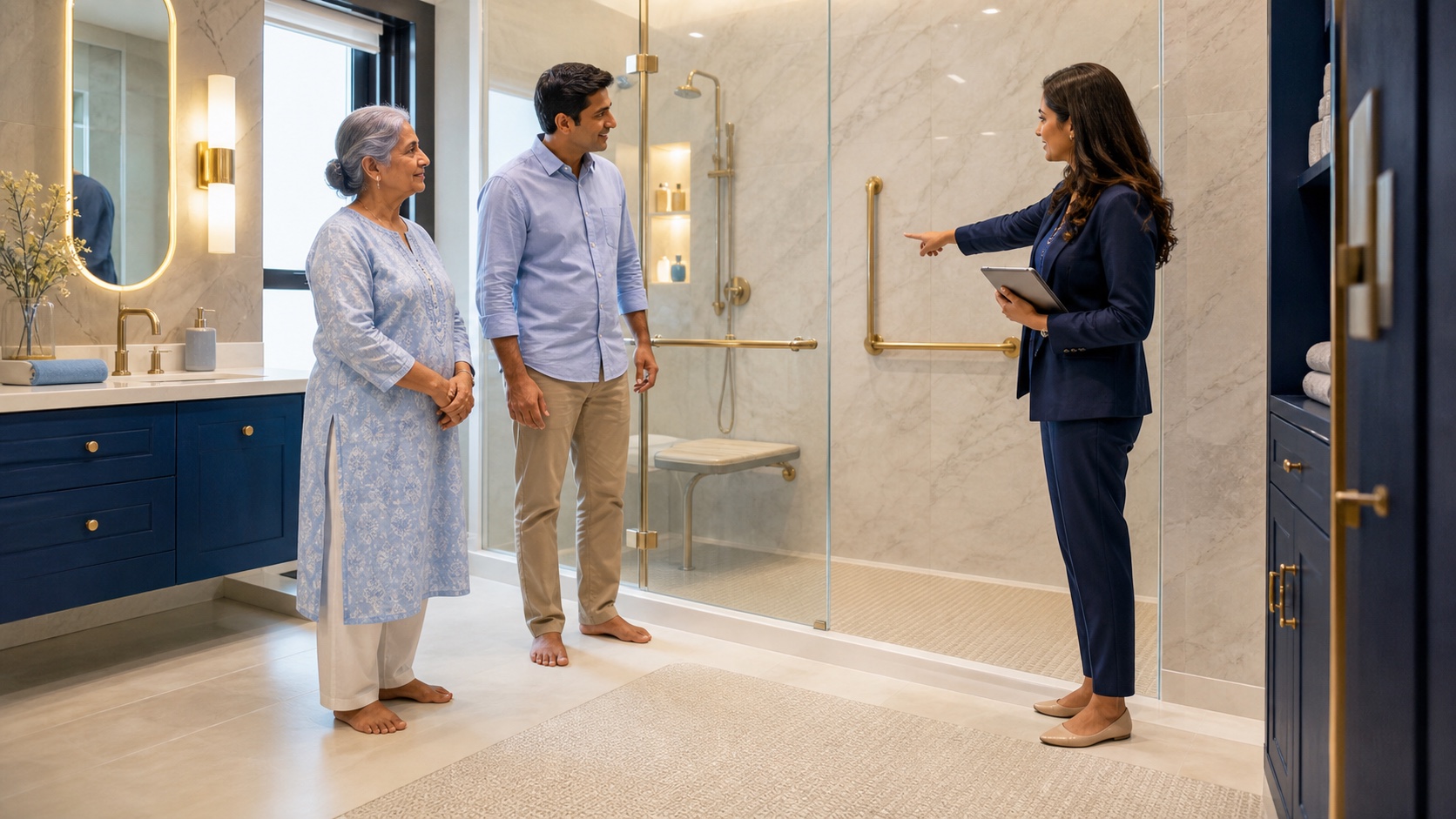
| Bathroom curb | It requires a wet step during one of the highest-risk daily routines. | Can the shower entry be flush, clearly visible, drained well, and supported by a grab point? |
| Balcony track | Low-contrast tracks are crossed often and may be wet after rain. | Is the track visible, lit, manageable in slippers, and safe while carrying something? |
| Loose rug or mat | Edges can move, curl, and catch feet, canes, walkers, or wheelchair wheels. | Can it be removed, fixed flat, or replaced with safer flooring? |
| Outdoor paving | Uneven stones, poor drainage, and glare can stop daily walking and temple visits. | Can the elder walk at dusk without watching every step? |
| Ramp design | A steep or slippery ramp can be more difficult than a step. | Does it have proper slope, landing, grip, handrail, drainage, and lighting? |
Age-friendly design scenes to inspect
A no-step home is not plain. It is a residence where beauty does not interrupt movement, recovery, or everyday confidence.


At a glance
Age-friendly design is quiet support
The strongest senior living environments do not make elders feel supervised or reduced. They make movement, rest, help, worship, meals, guests, and emergency response feel natural inside a beautiful home and community.
Questions families ask
Does no-step design reduce resale appeal?
Usually it broadens usability. Seniors, children, guests, people recovering from injury, wheelchair users, housekeeping teams, and emergency responders all benefit from fewer unnecessary level changes.
Are ramps always better than steps?
No. A ramp helps only when slope, landing, width, handrails, grip, drainage, lighting, and turning space are properly designed. A steep decorative ramp can create a new risk.
What is the most overlooked threshold?
Balcony and bathroom transitions are often missed because they look small during a quick site visit. They are used daily, often in low light, while wet, or while carrying something.
Should families remove all rugs?
Loose rugs are a common trip risk. If a rug or mat is necessary, it should be flat, fixed, high contrast, easy to clean, and not placed on a critical route such as bed to bathroom.
How can families test if a home is recovery-ready?
Imagine the elder using a walker for six weeks. Check whether they can enter, reach the bathroom, use the shower, reach the balcony, and leave for the lift without lifting the walker or stepping over hidden lips.
Sources